

How to Choose the Right LED Light Wattage for Every Room in Your Pakistani Home

LED Light Wattage: The Basics Before You Shop Room by Room
Getting LED light wattage right room by room is less about guesswork and more about two numbers working together. Most people still buy bulbs by watts, out of pure habit from the filament years. That habit no longer works. Watts describe how much electricity a bulb draws — lumens describe how much light it actually puts out.
Two bulbs rated at 9W can produce very different brightness. So the honest starting point is lumens, and watts become the follow-up question: how little power does this bulb need to hit that number?
The LED light wattage chart below is a working reference for common household bulbs. Figures assume good-quality LEDs producing roughly 90–100 lm/W.
| LED wattage | Approx. light output | Replaces (old bulb) |
|---|---|---|
| 3W | ~280 lumens | 25W incandescent |
| 5W | ~450 lumens | 40W incandescent |
| 7W | ~650 lumens | 50W incandescent |
| 9W | ~850 lumens | 60W incandescent |
| 12W | ~1,150 lumens | 75W incandescent |
| 15W | ~1,450 lumens | 100W incandescent |
| 18W | ~1,750 lumens | 120W incandescent |
Two bulbs on this chart can carry the exact same wattage and lumen rating and still feel different once installed. Colour rendering index (CRI) is the reason — it measures how true colours look under the light, and anything below 80 CRI tends to wash out fabrics, skin tones and kitchen counters. Most reputable LED lights sold in Pakistan now print CRI on the box alongside wattage, so it’s worth a glance before checkout.
Comparing wattage and lumens side by side is easiest with the bulb in front of you — Hyundai Power’s LED bulb range lists both figures on every listing, which makes this chart quick to double-check against real options.
Room-by-Room LED Wattage Guide for Pakistani Homes
Every room has a different job, so every room has a different brightness target — which is exactly why LED light wattage shouldn’t be the same number wall to wall. The figures below are totals for the whole room, not per bulb — a living room usually splits its output across three or four fixtures.
| Room | Total lumens | Total LED watts | Colour temperature |
|---|---|---|---|
| Living room | 2,500–3,500 | 24–36W | 3000K warm white |
| Bedroom | 1,400–1,800 | 15–19W | 2700–3000K |
| Kitchen | 2,800–3,500 | 30–36W | 4000K neutral |
| Bathroom | 900–1,400 | 10–15W | 4000K neutral |
| Study or home office | 2,000–2,800 | 21–30W | 4000–5000K |
| Dining area | 1,500–2,000 | 16–21W | 3000K warm white |
| Hallway or stairs | 500–900 | 5–9W | 3000K warm white |
| Porch or outdoor | 1,000–2,000 | 10–20W | 4000–5000K |
| Store room or garage | 800–1,200 | 9–13W | 4000K neutral |
| Children’s room | 1,200–1,600 | 13–17W | 3000–3500K |
In Pakistani homes the ceilings often sit higher than the international averages these charts are built on. Light spreads and weakens over that extra distance, so add roughly 10–15% to the totals above for rooms with ceilings over ten feet.
Children’s rooms deserve a slightly cooler tone than the rest of the sleeping areas — 3000–3500K keeps homework and reading comfortable without the harsher edge of a full daylight bulb. Store rooms and garages, by contrast, are almost never used for long stretches, so a single mid-range fixture on neutral white is usually enough rather than lighting the space as generously as a living room.
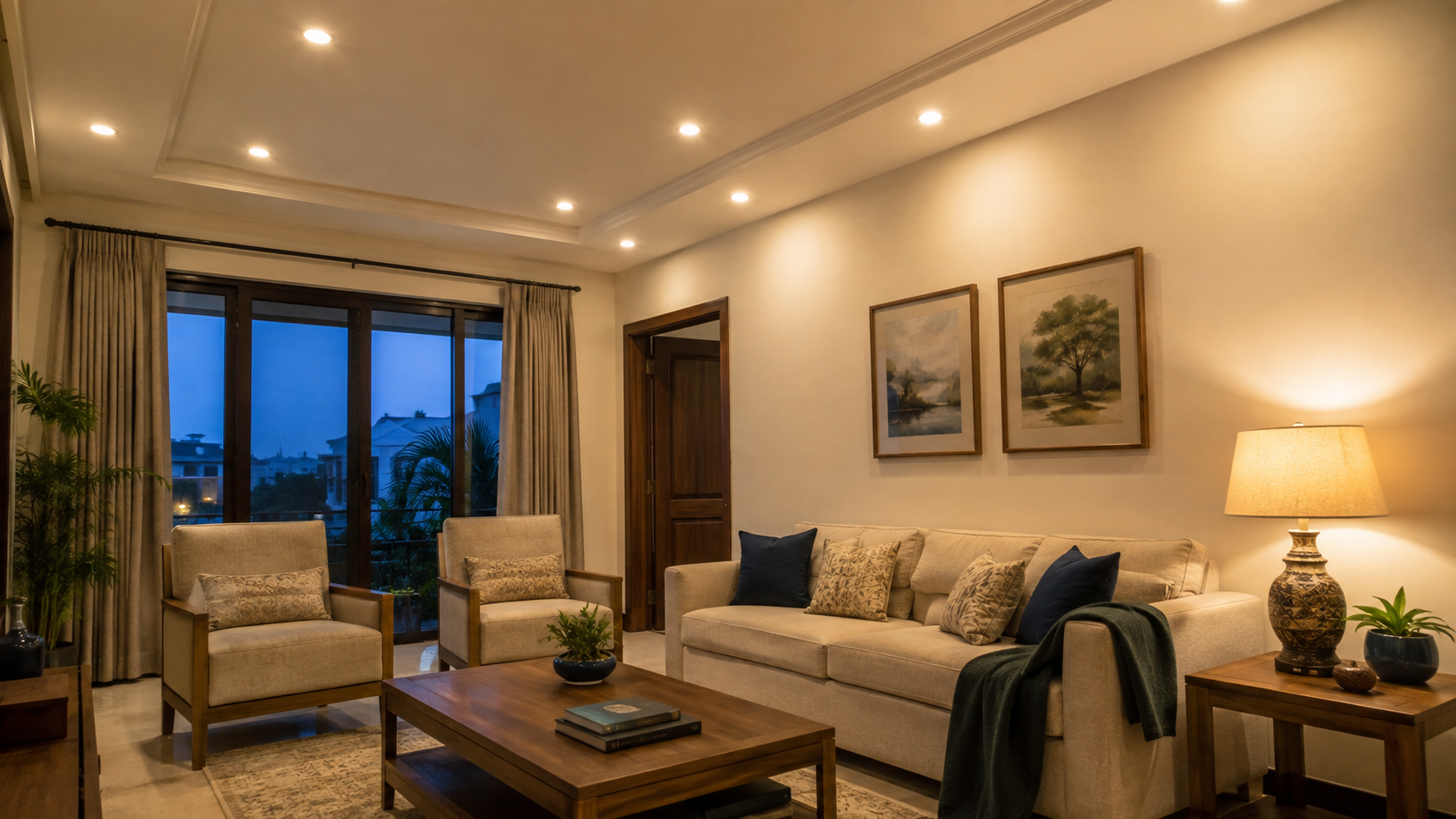
Living rooms and studies often split their wattage target across ceiling-recessed fixtures rather than a single bulb — the downlight range is worth a look if you’re planning the layout that way.
How to Calculate the Right Wattage for Any Room Size
When a room falls outside the table — an oddly long drawing room, a small servant quarter, a converted store — three steps settle it.
- Measure the floor area. Multiply length by width in feet.
- Multiply by the room’s brightness factor. Use 15 for living and dining spaces, 10 for bedrooms, 25 for kitchens and studies, 20 for bathrooms, 8 for hallways.
- Divide the lumen total by 95. That gives the approximate wattage needed across all fixtures in the room.
A 12ft × 14ft bedroom works out to 168 sq ft. At a factor of 10 that is 1,680 lumens, which divides down to about 18W — comfortably handled by two 9W bulbs.
A 10ft × 12ft kitchen runs the same formula differently. That’s 120 sq ft, multiplied by the kitchen factor of 25 for 3,000 lumens, divided by 95 for roughly 32W total — split across a central fixture and a strip of task lighting under the cabinets, since a single ceiling bulb leaves the counter in its own shadow.
Pro tip: resist the urge to round upward. Over-lighting a small room causes glare, harsh shadows and eye fatigue, and it shows up on the bill every month. Two moderate fixtures almost always beat one oversized bulb.
Common LED Wattage Mistakes to Avoid
- Buying by old-bulb habit. Asking a shopkeeper for “a 60W bulb” when LEDs don’t work in incandescent watts anymore just guarantees a mismatch — ask for the lumen output instead.
- Lighting every room the same brightness. A kitchen and a bedroom have different jobs; copying one wattage across the whole house wastes electricity in some rooms and leaves others too dim.
- Ignoring colour temperature. A technically correct wattage in the wrong colour temperature still feels off — a cool white bulb in a bedroom rarely feels restful, no matter how accurate the lumen count is.
- Skipping the CRI and efficacy numbers. Two bulbs with identical wattage and lumens can still differ sharply in colour accuracy and running cost.
- Assuming bigger is always safer. An oversized fixture doesn’t just waste power — in small rooms it actively makes the space harder to use comfortably.
Why Efficacy Still Matters, Even at Home
Efficacy is simply the light a bulb delivers for each watt it consumes, measured in lumens per watt. It is the number that separates a good bulb from a cheap one that merely looks identical on the shelf.
Budget LED lights often manage 65–75 lm/W. Well-made ones reach 95–110 lm/W. That gap means one bulb needs 13W to light a hallway while another does the same job on 8W — every evening, for years.
This is where energy efficient LED light bulbs earn back their slightly higher shelf price. Households replacing older lighting throughout the home typically cut lighting consumption by well over half, and the better the efficacy figure, the deeper that cut goes.
Efficacy is printed on the box of most quality LED lights sold in Pakistan. It takes five seconds to check and it is the single most useful number on the packet — more useful, in most cases, than the wattage figure printed right beside it.
Over a bulb’s working life, that few extra lm/W adds up to real rupees saved on the electricity bill, simply because a more efficient bulb draws less power to produce the same room brightness night after night. It’s a one-time comparison at the shop that keeps paying back for years.
Key Takeaways
- Shop by lumens first; treat watts as the efficiency question that follows.
- Roughly 9W replaces an old 60W bulb, and 15W replaces a 100W one.
- Warm white suits bedrooms and living rooms; neutral or cool white suits kitchens, bathrooms and study areas.
- Area × brightness factor ÷ 95 gives the wattage for any room.
- Add 10–15% for high ceilings, and never over-light a small space.
- Check the lm/W rating on the box — energy efficient LED light bulbs pay for themselves through it.