

Downlight vs Panel Light

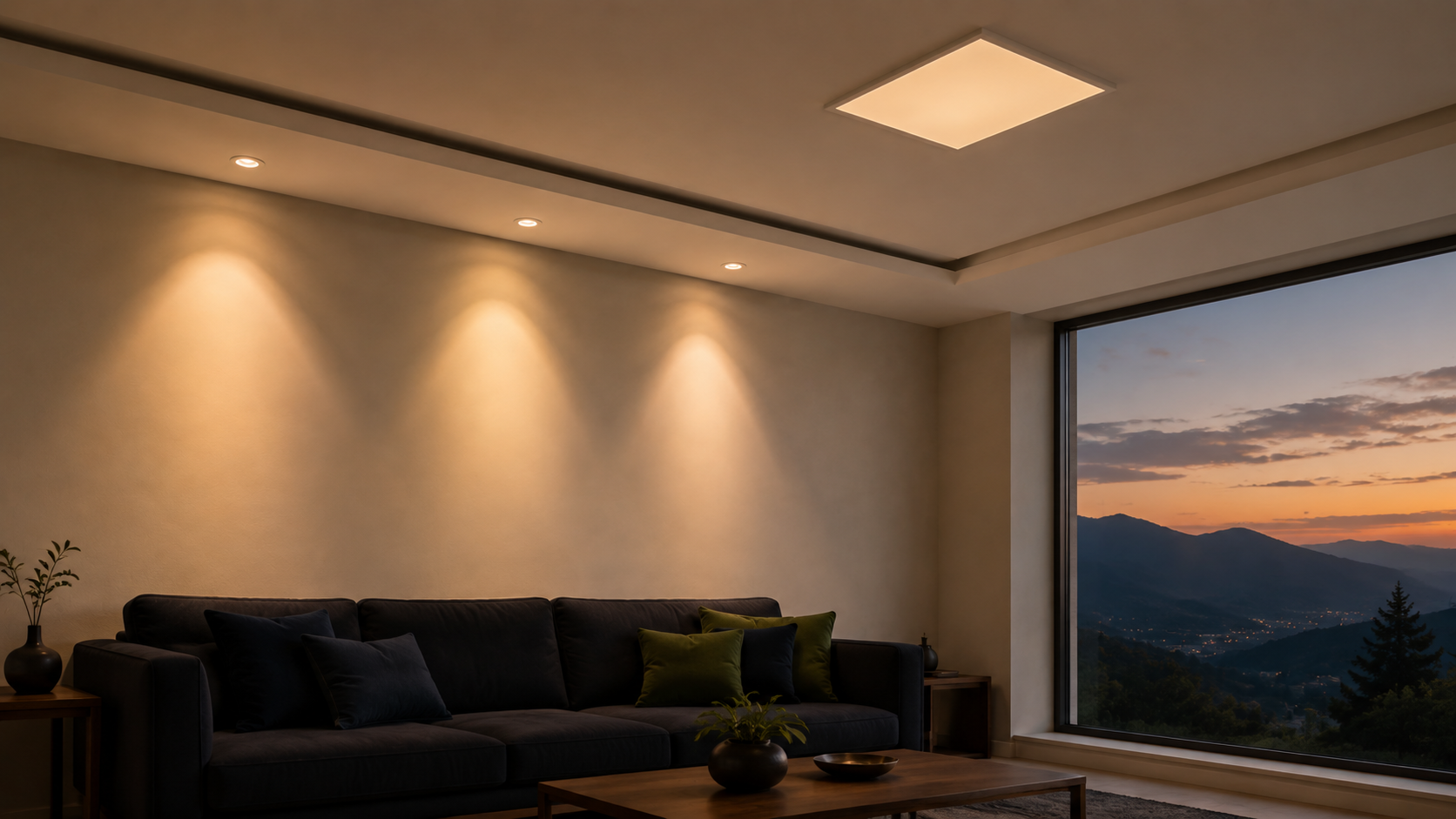
Downlight vs Panel Light: The Core Split
Choosing between a downlight vs panel light comes down to one thing — beam shape. A recessed downlight throws a pooled cone of light straight down; a flat panel spreads an even wash across the whole room.
That decides placement. Pooled beams suit light that must be aimed — a sofa, a dining table, a reception desk. Even washes suit spaces needing uniform floor brightness.
Glare is the second split. A panel light spreads output across a large diffuser face, so eyes stay comfortable through long working hours. Recessed fittings win on depth and contrast instead.
Deeper single-type reads: the LED down light guide for Pakistan
COB vs SMD Downlight: Which Chip Type
Once the recessed route is settled, the next question is which chip sits inside the downlight housing. COB means chip-on-board — many LED chips bonded onto one substrate, behaving as a single emitter. SMD uses separate surface-mounted diodes behind a diffuser.
The practical difference is beam control. COB gives a tight 15° to 38° beam, ideal for accent and task work. SMD spreads 90° to 120° for softer general light without hotspots.
Heat is the quality signal. COB drives all its output through one point, so the aluminium body must carry that heat away. In Pakistani homes, where evening voltage sags then spikes as load-shedding ends, thin-bodied fittings fail first.
Browse the COB fittings,
LED Downlight vs Spotlight: The Confusing Pair
This is the pair buyers mix up most, and the line really is blurry. A spotlight is defined by its beam — narrow and aimable. A recessed fitting is defined by its position.
Local wiring shops reflect that overlap. Hyundai’s own COB range sells under the Spot Light name, because electricians here name a fitting by its beam, not its mounting.
The rule that works: a wide-beam fixed unit lights a room; a narrow-beam spotlight highlights an object. Most ceilings need both layers — general coverage plus a few aimed at artwork.
Matching Hyundai stock sits on the sister storefront too — the Spot Light collection covers tight-beam units.
Cutout, Wattage and Spacing
In a gypsum or POP false ceiling the cutout must match the fitting exactly. Common sizes are 75 mm, 90 mm, 110 mm and 150 mm. Three to five millimetres of tolerance is workable.
- 3–7 W at 75 mm — corridors, wardrobes and accent points
- 9–12 W at 90–110 mm — bedrooms and drawing rooms
- 15–20 W at 150 mm — kitchens, task zones and high ceilings
- 18–48 W panel lights, 2×2 ft or round — offices and shop floors
Spacing follows ceiling height. For a 9 to 10 ft false ceiling, space downlights at roughly half that height — 4 to 5 ft apart — with the first row 2 ft off the wall.
Colour temperature matters as much as wattage. 3000K reads warm, 4000K neutral, 6500K cool. Mixing all three in one false ceiling is the commonest finish mistake in Pakistani drawing rooms. Ready-made options in these sizes are stocked on the sister storefront’s panel collection.
| Fitting | Cutout | Wattage | Beam |
|---|---|---|---|
| COB recessed | 75–90 mm | 5–12 W | 15°–38° |
| SMD recessed | 90–150 mm | 7–20 W | 90°–120° |
| Recessed panel | 2×2 ft cut | 18–48 W | 120° |
| Surface panel | No cut needed | 12–36 W | 120° |
Pick by Room: Quick Recap
| Room | What to fit |
|---|---|
| Drawing room | COB downlights on the perimeter, plus a few aimed at the feature wall |
| Bedroom | Warm 3000K SMD units, dimmable if wiring allows; skip 6500K |
| Kitchen | 15–20 W at 4000K, spaced 3 ft along the counter |
| Office | Flat panels for even, low-glare desk coverage |
| Corridor | Small 3–7 W units at 4 ft centres |
Frequently Asked Questions
Which is better for a false ceiling — a downlight or a panel light?
Neither is universally better. Recessed units give pooled, directional light and visual depth, suiting drawing rooms and accent zones. Flat panels give even, low-glare coverage for offices.
What is the difference between COB and SMD?
COB bonds many chips onto one substrate for a tight 15° to 38° beam, best for accent and task light. SMD uses separate diodes behind a diffuser for a wider 90° to 120° spread.
Is a spotlight the same as a recessed ceiling light?
Not exactly, though the terms overlap locally. A spot is defined by its narrow, aimable beam; a recessed fitting by sitting flush in the ceiling. A tight-beam COB unit is both.
What cutout size is needed?
Common cutouts are 75 mm, 90 mm, 110 mm and 150 mm. Match the hole saw within three to five millimetres, or the trim ring will not sit flush.
How far apart should ceiling lights be spaced?
Space them at roughly half the ceiling height — about 4 to 5 ft apart on a 9 to 10 ft ceiling, with the first row 2 ft from the wall.