

LED Spotlights Guide: Make Every Shop Display Stand Out with the Right Beam

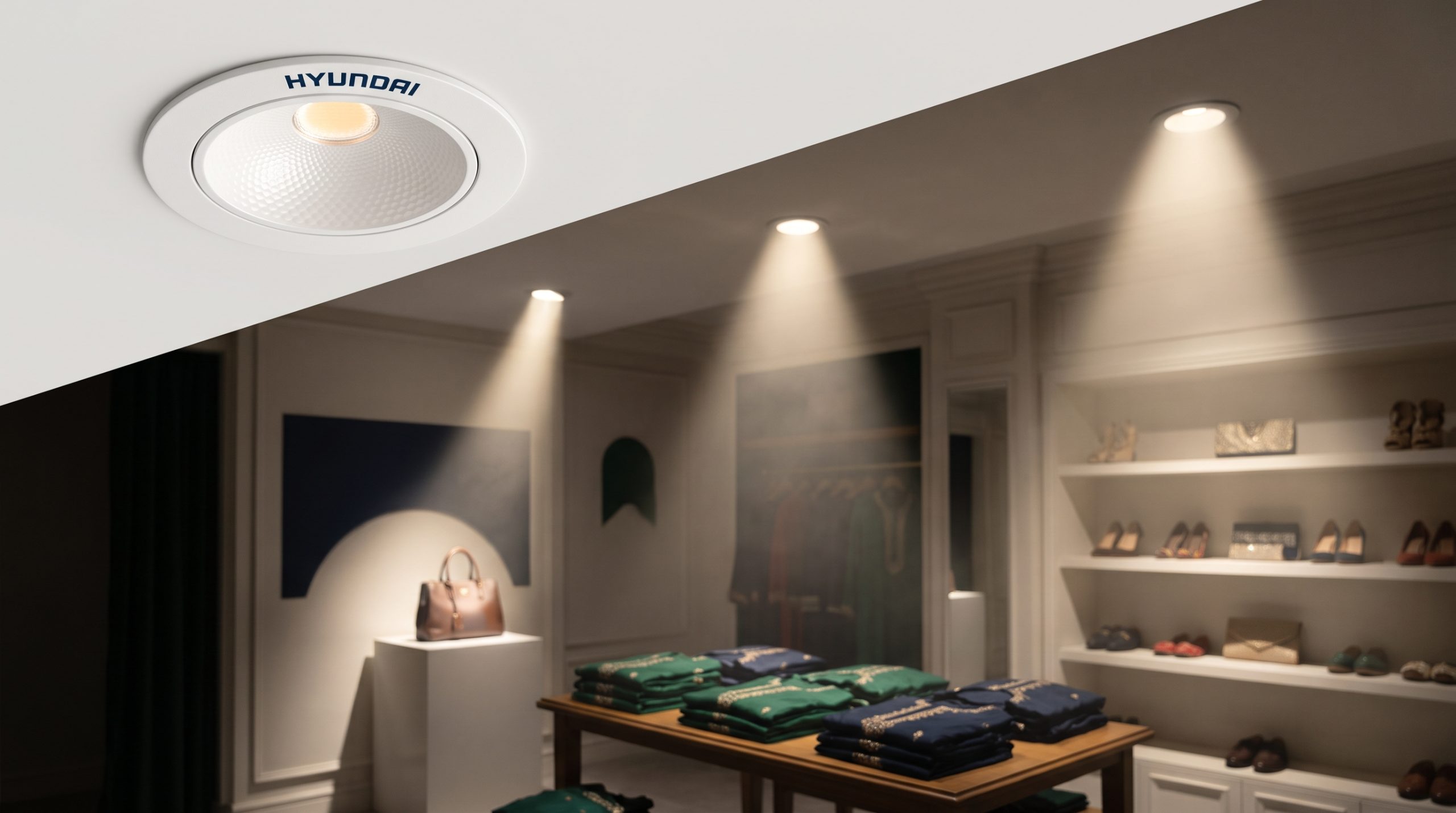
LED Spotlights: Beam Angle Decides What Gets Seen
On a shop ceiling, the spotlight beam angle matters more than wattage. It is the cone’s width in degrees, measured where intensity falls to half the centre value, and it decides whether one handbag glows or a whole shelf gets a flat wash.
Whether a ceiling needs ambient or aimed fittings is settled in the downlight versus panel light comparison. This LED spotlights guide covers the selection maths that follows.
Pool size follows simple geometry: diameter ≈ 2 × distance × tan(half the angle). With a 3 m ceiling and a 1 m counter, the fitting sits 2 m from the product, and narrow beam vs wide beam becomes a clear choice.
As a rule, the best beam angle for shop display work is 30° for a single hero product, 45° for grouped tables and 60° for shelving, where even coverage matters more than drama. Why a compact chip-on-board emitter makes tight beams easier to engineer is explained in the COB LED guide.
Wattage and Lumens per Display
Wattage for display lighting is only half the brief, because the angle sets how concentrated the lumens land. The HL3CB6N gives 360–420 lm through 45°; the HL4CB12N-C gives 840–960 lm across 60°. A 7W unit at 30° can look brighter on the product than a wider 12W.
Contrast makes accent lighting work. A common lighting-design rule of thumb is about 3:1 against the ambient level for clear emphasis and 5:1 or more for a hero display. Under bright overhead panels, tighten the beam before adding fittings.
For project quantities, the full cob spot light range lists every wattage and beam together, making it easier to standardise one model per zone.
Smaller shops buying an LED spot light for retail display in single units can order Hyundai COB fittings through the Hyundai Power COB collection.
Aiming and Spacing Accent Lights
Light should strike merchandise at about 30° from vertical, which lights the front face, keeps glare out of customers’ eyes and avoids reflections on glass. On a 3 m ceiling lighting goods at about 1.5–2 m height, mount fixed fittings roughly 0.6–0.9 m out from the wall; on a 4 m ceiling, move them further out.
Accent light spacing follows pool width. For an even wash along a shelf, set centres slightly under one pool apart so the edges overlap: 45° units at 2 m (a 1.7 m pool) sit roughly 1.5 m apart. For separate highlights, leave deliberate gaps; the darkness between pools creates contrast.
Fixed or Adjustable Heads
The fixed vs adjustable spotlight choice depends on how often the layout changes. Fixed recessed units are cheaper and neater for permanent features such as the cash counter or a brand wall.
Clothing shops in Pakistan reset displays for Eid, wedding season and winter stock, so aimable heads earn their cost there. The Hyundai Power track light collection covers that movable-head format.
CRI and Voltage in Pakistani Shops
The colour rendering index measures how faithfully a source shows colours against a reference light. The Hyundai range is specified at CRI ≥80, which suits packaged goods, electronics, footwear and general stock.
CRI for retail lighting rises with the value of colour to the sale. Jewellery, bridal fabric and cosmetics usually justify CRI 90+, so confirm that rating in writing before ordering. Tone matters too, as the guide to which LED colour is easiest on the eyes explains.
In Pakistani bazaars, voltage often sags in the evening as every shop on the row switches on, then jumps when load-shedding ends. A driver with a wide rated input range rides out that sag, so check it on the datasheet. On large ceilings, the PF 0.9 variants (HL4CB12N2-C, HL3CB6N2-C) draw less line current and ease the load on cabling and breakers.