

High Bay vs Low Bay Lights — LED high bay vs low bay lighting for Pakistani warehouses and factories

What Mounting Height Makes a Fixture High Bay
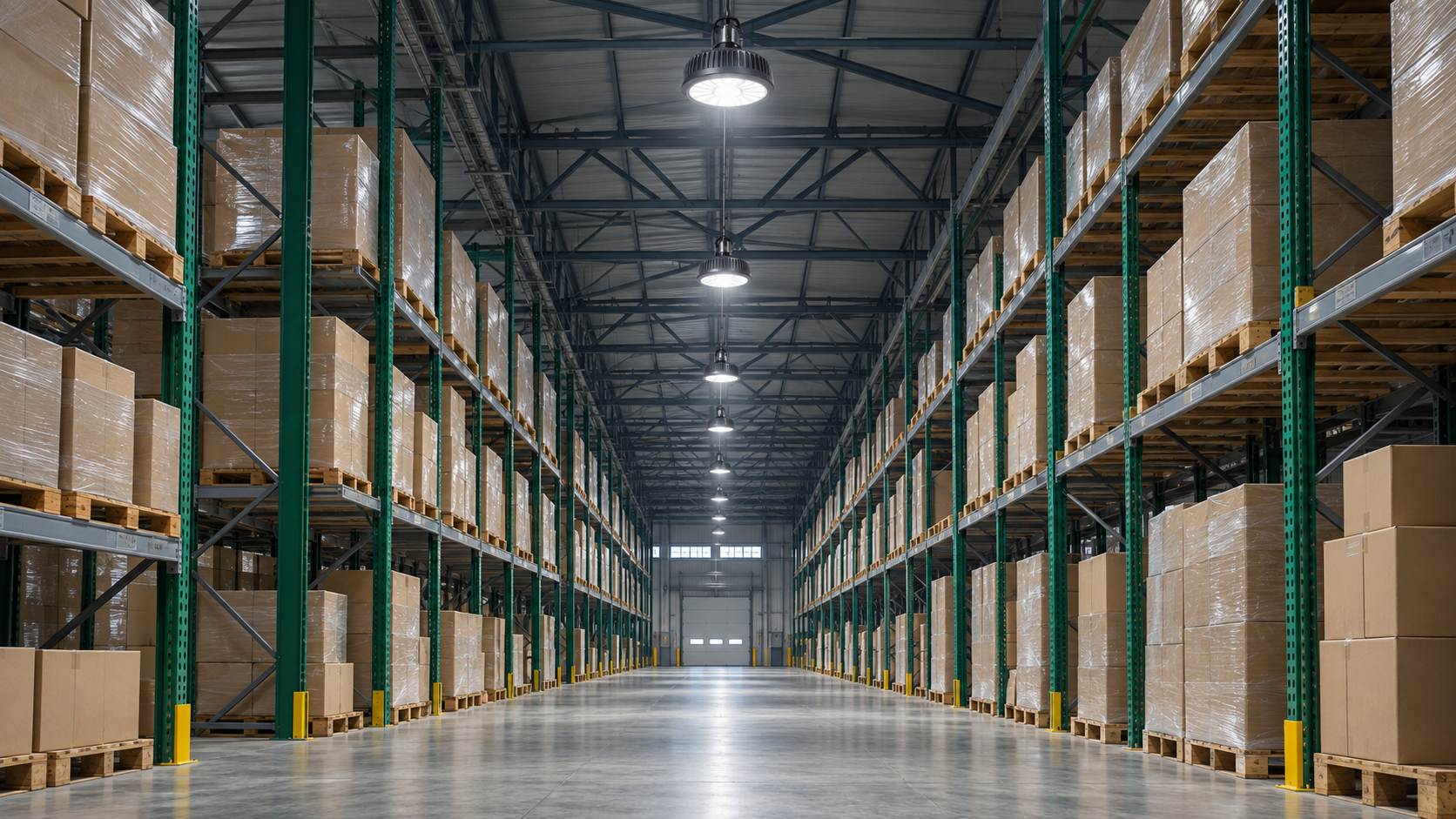
High bay vs low bay is decided by ceiling height, not by wattage and not by floor area. A fitting is classed as high bay once it sits roughly six metres or more above the finished floor.
Most purpose-built sheds in Pakistan sit inside that band. A racking warehouse on the Lahore–Sheikhupura or Faisalabad belt is usually built to seven or nine metres of clear height, while older converted units stop at five.
That gap matters more than buyers expect. Specifying by wattage alone — “we ran 400 W metal halide, so quote 200 W LED” — ignores the optics, and it is why re-lamped factory floors go bright underneath and dim between.
High Bay vs Low Bay: Where the Line Sits
The high bay vs low bay decision comes down to beam control. A low bay optic spreads light wide; push it to ten metres and that light scatters onto racking and walls instead of the aisle floor.
Fittings built for the upper band answer that with tighter optics and much larger lumen packages. As mounting height climbs, the beam narrows and output per unit rises — that trade-off is the whole design.
| Mounting height | Fixture class | Typical beam | Output per unit |
|---|---|---|---|
| Under 4 m | Low bay | 110–120° | 2,000–6,000 lm |
| 4–6 m | Low bay | 100–120° | 6,000–12,000 lm |
| 6–9 m | High bay | 90–120° | 15,000–24,000 lm |
| 9 m and above | High bay, narrow optic | 45–90° | 24,000 lm+ |
Attached offices and QC rooms in the same building are a different job, and recessed panels serve them better. The LED panel light guide covers sizes, grid fit and glare control for those spaces.
Where that office ceiling is a suspended grid, panel construction changes the result, and a comparison of backlit and edge-lit panels settles the choice quickly.
UFO or Linear: Choosing the Form Factor
Two form factors dominate. The UFO type is a compact round fitting on a die-cast aluminium heatsink, suited to open floor, pallet storage and tall clear-span sheds where light comes straight down.
The linear type throws light along an axis rather than in a circle, which suits racking aisles and assembly lines. A flood light is not a substitute — flood optics are asymmetric and built for yards and facades.
Linear units are also the natural swap for the twin and quad T8 batten rows still running in Pakistani plants. Our own high bay light range covers both form factors across the common industrial wattages.
Lux Targets by Industrial Task
Lighting design starts from the task, not the building. The same warehouse can need 100 lux over static pallet storage and 500 lux at an inspection bench, and one blanket figure fails both.
Illuminance is measured in lux — lumens landing on a square metre of the working plane. The figures below are maintained targets: the level the installation must still hold at its next service interval.
| Area or task | Maintained lux | Design note |
|---|---|---|
| Circulation and walkways | 50–100 lx | Safety minimum, not a work level |
| General pallet storage | 100–150 lx | Static stock, low activity |
| Racking aisles and picking | 150–200 lx | Vertical light on rack faces |
| Despatch and packing | 300 lx | Barcode legibility |
| Assembly and production | 300–500 lx | Uniformity 0.4 or better |
| Inspection and fine QC | 500–750 lx | Uniformity 0.6, CRI 80 up |
Uniformity is the other half of the spec and gets skipped constantly. A floor averaging 200 lux but swinging from 90 to 400 across an aisle still reads as badly lit.
How Many LED High Bay Lights a Building Needs
The count for LED high bay lights falls out of three numbers: target lux, floor area and the output of one fitting. A 1,000 m² hall at 150 lux needs 150,000 lumens, or 187,500 after a 0.8 maintenance factor.
That is roughly ten fittings of 20,000 lumens. Spacing then comes from mounting height — one to one-and-a-half times the height suits general areas, tightened where racking blocks the throw.
Lumens drive that entire calculation, not watts, and the LED light wattage guide sets out the lumens-per-watt fundamentals behind it.
IP Rating and Heat on Pakistani Factory Floors
Ambient temperature is the spec most often missing from an industrial enquiry. Under a steel roof in Punjab, air at fitting level sits at 45–50 °C through June and July — not the 25 °C on the datasheet.
Ask for the rated ambient, shown as Ta, and hold out for 50 °C. Electrolytic capacitors in the driver fail first when a fitting runs hot, so the driver deserves more scrutiny than the housing.
IP rating should follow the process. Textile halls, flour mills and open-sided sheds justify IP65; a climate-controlled assembly room does not. Heatsink mass matters too — die-cast aluminium beats a stamped fin on a hot factory floor.
What Drives Running Cost at Industrial Scale
Efficacy is the lever. A fitting at 150 lumens per watt draws a third less power than one at 100 lumens per watt for the same lux — across a hundred fittings that is the business case.
Replacement labour is the cost nobody budgets. Changing a lamp at ten metres means a man-lift, a permit and a production pause, which often costs more than the fitting itself.
So an L70 of 50,000 hours is a maintenance number, not a marketing one. Ask for the LM-80 data behind it, read what the warranty excludes, and use motion sensing in low-traffic aisles to cut burn hours.
| Check | Why it matters |
|---|---|
| Measure the mounting height first | Six metres is the dividing threshold; wide optics win below it. |
| Set lux by task | 100 lux over pallet storage, 500 lux at inspection — one warehouse. |
| Count fittings from lumens | Target lux × area ÷ 0.8, divided by output per fitting. |
| Demand a Ta of 50 °C | Roof-level heat in Punjab destroys drivers rated to 25 °C. |
| Buy efficacy, not watts | 150 lm/W against 100 lm/W is a third off connected load. |
Frequently Asked Questions
At what mounting height do LED high bay lights become necessary?
Roughly six metres above finished floor level. Below that, low bay or batten fittings with wider optics give better uniformity; above it, narrower beams are needed to reach the working plane.
High bay vs low bay: what is the real difference?
Beam angle and lumen output. Low bay optics spread light across 100–120 degrees for short drops, while fittings for taller buildings use tighter beams and higher output.
How many lumens does a warehouse need per square metre?
Multiply the target lux by floor area, then divide by a maintenance factor of about 0.8. A 150 lux target over 1,000 square metres needs roughly 187,500 lumens installed.
Are UFO or linear fittings better for racking aisles?
Linear, in most cases. Its beam runs along the aisle rather than across it, lifting vertical illuminance on rack faces and cutting the shadowing round fittings create between runs.
What IP rating suits a Pakistani factory floor?
IP65 where dust or moisture reaches the fitting — textile, flour, cement and open-sided sheds. A climate-controlled assembly hall is fine at IP20, and sealed fittings there only add cost.